A Policy Revolution?
Is Carney's Pivot a Sign of Things to Come

For decades after the Cold War, Canadian foreign policy rested on a specific bet that has not gone as planned. The thinking was simple: Russia and China were the problems, the U.S. was the solution, and Canada’s best move was to embed itself as deeply as possible into the American orbit. That logic is now falling apart. The trouble isn’t just a messy global landscape; it’s that Ottawa missed the warning signs coming from its own backyard.
This old model took for granted that being close to Washington meant being safe. Success was measured by how well Canada could mirror U.S. sanctions, protect cross-border trade, and play its part in the Five Eyes. Diplomacy was mostly about branding Canada as a “nice guy” on the world stage. Economically, we were so focused on keeping the border open that we ignored the danger of putting every egg in the American basket.
That comfort zone bred a dangerous level of unpreparedness. As American politics turned inward and transactional, the same heavy-handed tactics used on enemies—tariffs and regulatory bullying—started hitting allies too. Canada’s real weakness wasn’t a threat from across the ocean, but its total reliance on a neighbor that could change friendship into vassalage.
The biggest analytical mistake was misjudging where the real disruption would come from. By fixating on “rogue states,” Ottawa tended to downplay the damage U.S. unilateralism could do. Trade wars and threats to scrap treaties caught Canada off guard, proving that when Washington uses its market as a weapon, Canada has leverage that is perhaps not up to the task.
Despite forewarnings that demonstrated the need to prepare (see my vulnerabilities paper here and related Policy Options and IPD reports cited in my substack best case scenario) a new reality is being forced upon Canada. Ottawa can no longer treat the U.S. strictly as a big brother; it’s now a partner that can just as easily become a bully.
My co-authored research shows that in a multipolar world the Relative Gains problem is acute. What this means is that the US, no longer content with Absolute Gains is obsessed with ensuring it gains more than its competitors. This strategy plays out in several ways - the pursuit of “spheres of influence” is one but more importantly is -the “strategy of denial.”
That is why the US preoccupation with unilateral action in pursuit of relative gains goes beyond confrontations with Iran, Russia and China. In today’s multipolar world, the US rivalry with its adversaries has led it to focus on weaker and smaller states where geopolitical rivalries are played out. America’s partners are viewed as either assets to be harvested or liabilities to be controlled.
That doesn’t mean the alliance is dead, or that our relationship isn’t worth salvaging. It does mean that the terms of that relationship must change. Today the goal for Canada is shifting from total integration or what some called “Fortress North America” to the possibility of a type of “strategic autonomy”—the basic ability to keep the country running if the relationship with Washington hits a wall.
Some might argue that true “strategic autonomy” is not possible without a completely independent deterrent capacity. For some that deterrent can be best achieved with nuclear weapons. But this is not the only view.
For starters, greater autonomy means shifting from a purely defensive trade and security stance, towards something more self-reliant. In essence moving from a reactionary - “policy taker” to a proactive “policy maker.” There is some urgency to this shift. US negotiator Jamieson Greer recently stated Canada must accept "some level of higher tariff" and participate in "reshoring" American jobs if it wants to keep the CUSMA trade deal.
This is exactly the "Salami-Slicing" I predict in my vulnerabilities paper. In essence Greer is incrementally raising the "cost" of Canadian trade independence. By invoking Section 122 (based on “Balance of Payments” crises) immediately after losing the IEEPA case at SCOTUS, Greer is proving my point that the US will simply pivot to whatever legal ambiguity is available to maintain pressure and uncertainty.
By keeping the "rules" of the relationship slightly unclear ( Zombie CUSMA) the US has created a permanent state of anxiety for Canadian investors. This isn't a by-product of a messy democracy; it’s a tool used to ensure Canada doesn't drift toward independent trade deals.
Instead of just seeking exemptions and carve outs to U.S. rules, the Carney government is trying to build things here, in ways that have not been tried for a very long time. Money is or will be flowing into mines, factories, and energy projects not just for profit, but for greater autonomy. If you can build it yourself, a sudden tariff or a border closure doesn’t feel like an existential threat.
Ottawa is also looking for friends elsewhere. Deals with Europe, the Asia-Pacific, and the Gulf are no longer just PR exercises; they are insurance policies. Finding other places to sell goods and source parts is basic risk management. We can’t outmuscle the giants, but we can stop being dependent on just one of them.
The military and security side is seeing the same shift. The focus is moving away from just buying American parts to building up our own gear and Arctic infrastructure despite criticisms of inefficiency and even perhaps protectionism. Intelligence sharing is still the backbone of the system, but the government finally realizes that a seat at the table doesn’t matter if you don’t have the hardware to back it up. Even there Canada is hedging its bets by linking up with likeminded allies in the EU.
Even the way Canada talks to the world is getting a reality check. We still care about democracy, but we’re becoming more transactional. Ottawa is talking to whoever it needs to, even if they don’t share all of our values, because shouting from the sidelines isn’t a strategy. In a world this competitive, if you don’t have something to offer, nobody is listening.
This change may well be a massive culture shock for the civil service. For a generation, officials were taught that “aligning with the U.S.” was the right answer to every question. To the point that it was rare for bureaucrats to call out or even condemn US behaviour.
Now, they need to learn a different trade: how to build domestic strength and find new markets in a world where the old rules don’t always apply, without blaming all this on the US. It’s not just a change in policy; it’s a major rethink of what Canada is and how it must muster the domestic strength to overcome adversity.
The failure of the old socialization model is not limited to policy. It also shapes teaching and research in Canadian universities, especially in public policy schools. For years, students in international affairs were effectively trained to operate within U.S.-centric frameworks. Careers in global affairs often meant learning to “speak Washington”—adapting to American strategic priorities, values and institutional norms.
But what we discovered is that socialisation process wasn’t always a two way street. While Canadian students and experts were attuned to the way American trade negotiators and defence specialists think and work, their American counterparts did not share the same interests in understanding Canada. Sometimes that friction was palpable in cases where visiting U.S. defence experts publicly expressed values that were at odds with our own.
Research agendas frequently assumed that alignment with U.S. preferences was the default baseline for Canadian policy. This assumption has become problematic. As my best case scenario shows, there are multiple options we have yet to explore beyond this baseline.
Unfortunately, a rigid binary intellectual orientation narrowed debate and the search for options. Risks posed by authoritarian states were studied and called out extensively, but the structural risks of dependence on the United States received comparatively less scrutiny especially in public policy schools across Canada.
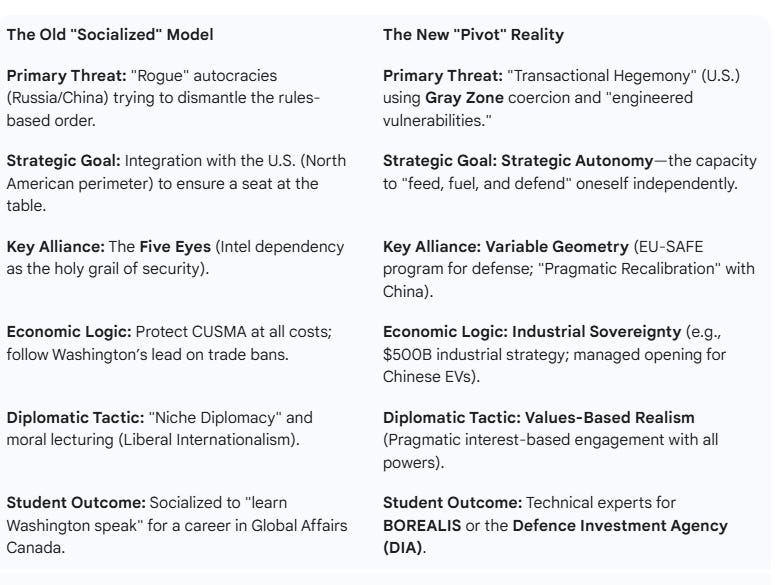
Few programs treated American unilateralism, or economic coercion as core research problems, and when they did, it was usually in a stove piped manner specific to a particular issue in trade, security or defence, or in the form of a specific policy brief focused on one specific file (such as Canada’s position on the ICC). As a result, policy professionals have become less prepared to think systematically about managing asymmetry within the alliance itself and more importantly, the shift from a “value-based partnership” to an asymmetric transactional relationship. The net outcome of this socialisation process is threefold
Failure of Diagnosis: By training students to see the U.S. as a protector, partner and ally whose values were in lockstep with our own, the establishment left a generation of policy-makers potentially blind to American gray zone tactics. When the 2025 tariffs hit, alongside threats of invasion, decertification of aircraft, incursions into the NW passage and support for separatism, those socialized in “Washington Speak” had no intellectual framework to treat an ally as a threat.
The “Vassal” Trap: The old model defined success as “influence through integration.” Carney’s pivot and my co-authored research which examines this shift since 9/11, shows that integration has actually led to subordination. In this view, the old guard wasn’t teaching just diplomacy; they were teaching the management of Canadian decline through integration.
Strategic Rigidity: The “Good vs. Evil” binary makes “Variable Geometry” (working with China on trade while joining the EU for defence) look like a betrayal. To a pragmatist, however, this flexibility is the only way for a middle power to survive not only a trade war, but what former Prime Minister Stephen Harper described as an “Existential Threat".
In sum:
For ideas on how Canada can overcome these challenges, please see my Best Case Scenario in this sub-stack for potential pathways.
_________________________________________________________________________
This post produced with information collected and organised with the assistance of Gemini